AGA 57 Put Its Finger on a Caribbean Media Problem: Getting Our Stories Out
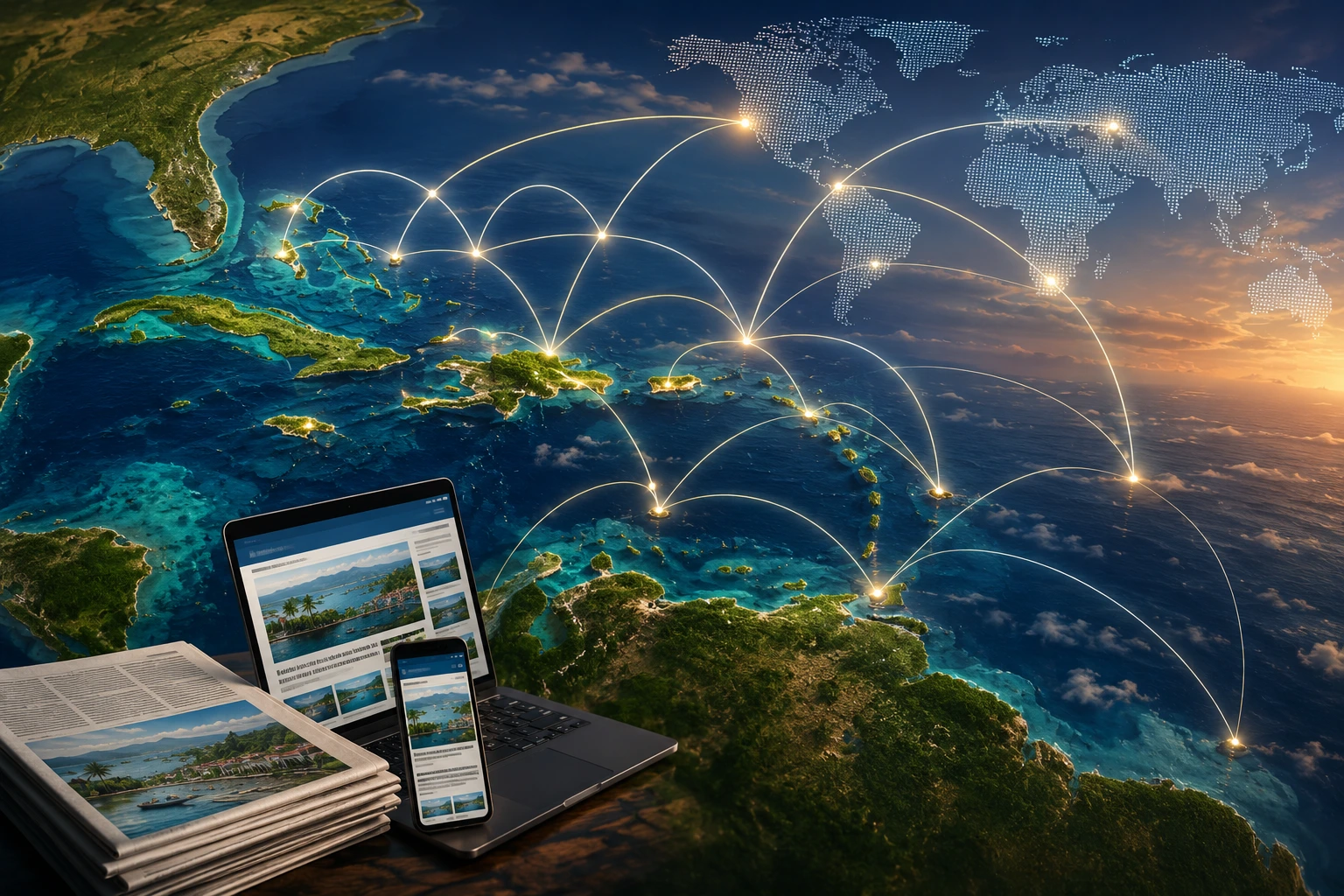
There is no shortage of Caribbean stories. Spend a morning looking through the region’s newspapers, radio sites and independent publications and the problem becomes fairly obvious. Plenty is being produced. Much less of it travels.
A political story published in Guyana may be important in Trinidad. A Dominican tourism story could interest readers in Jamaica or Barbados. Reporting about migration, energy, climate or crime frequently crosses borders in substance even when the article itself doesn’t.
That old problem found its way into the Caribbean Broadcasting Union’s 57th Annual General Assembly in Guyana this week. Artificial intelligence was inevitably part of the conversation, but underneath the AI discussion was a rather more practical question: how does Caribbean media get more of its own material in front of people outside its immediate market?
Guyana’s President Irfaan Ali put the matter quite plainly. Caribbean media, he argued, already have content. Technology should be used to distribute it farther and compete for audiences beyond the region.
There is an appealing simplicity to that argument, although distribution has never been quite as easy as the technology industry likes to suggest. Putting something on the internet technically gives it a global audience. So does leaving a book on a park bench. The difficult part is getting the right people to find it, trust it and want to read it.
Anthony Greene, President of the Caribbean Broadcasting Union, was noticeably cautious about treating technology as the answer to everything. He spoke about AI improving efficiency, audience reach and potentially revenue, while keeping editorial judgment, accuracy and trust where they belong—with people.
That caution is useful. Media have been promised technological salvation before.
AI certainly changes what is possible. Whether everything that is possible is also desirable is another question.
Erwin Jay Saunders of the Turks and Caicos Islands raised one application at AGA 57 that deserves more attention: translation. AI can now help Caribbean content cross language barriers at a speed and cost that would have been difficult for smaller publishers to contemplate only a few years ago.
For this region, that is no minor matter.
The Caribbean is geographically compact and linguistically fragmented. English, Spanish, French, Dutch and several Creole languages and varieties coexist across markets that are already small. An article can be highly relevant on the next island and still never get there in a form that people will read.
Translation helps, but anyone who has worked between Caribbean markets knows that translation isn’t enough. Readers in Kingston are not readers in Santo Domingo with the language switched. Neither are readers in Georgetown interchangeable with those in Willemstad or Miami.
References need explaining. Measurements, currencies and terminology differ. Headlines that work in one place fall flat somewhere else. Sometimes the whole emphasis of a story needs adjusting.
Editors have always done this sort of thing. AI merely makes some of the mechanical work faster.
The interesting question is what happens if that technology is placed between publications rather than used simply to manufacture more content inside each newsroom.
Could a publication in one Caribbean country make a story available to another, allow the receiving editor to adapt it for local readers and still preserve who wrote it and where it came from?
We should declare an interest here. That is very close to what we are trying to do with CaribPubsPro.
CaribPubsPro was being developed before AGA 57 and neither the CBU nor any of the speakers at the assembly has endorsed it. We are building a publisher-to-publisher system through which a publication can make a story available to another publication. The receiving side decides whether it wants it. AI can assist with translation, localization and adaptation, but an editor decides what, if anything, gets published.
At least, that is the theory.
The more useful test is what happens when real editors start using it. Perhaps they will find parts of the process unnecessarily complicated. Perhaps publishers will be reluctant to make good stories available to potential competitors. Perhaps attribution alone will not provide enough incentive. Those are precisely the things that cannot be discovered from a diagram or a business plan.
We are beginning those tests now.
There is a financial reason why the experiment is worth attempting. Caribbean publications generally operate in small advertising markets while competing online against organizations with vastly larger audiences and resources. The internet removed geographical limits on distribution, but it did not remove the economics of scale.
Regional cooperation might help. It might also prove harder in practice than it sounds from a conference podium.
News organizations compete. Editors are protective of their material. Publications have different standards and political cultures. Some will happily receive stories while being considerably less enthusiastic about sharing their own. Technology doesn’t make any of those tensions disappear.
What it can do is remove some of the friction.
That may ultimately be AI’s more useful role in Caribbean media—not writing thousands more articles, but helping existing stories move between languages, publications and audiences without stripping away their origin in the process.
AGA 57 did not produce a grand solution to the distribution problem. Probably just as well. Caribbean media have seen enough grand solutions.
But several speakers appear to agree on something more basic: the region produces stories that ought to travel farther than they do.
Now somebody has to work out how to make that happen.
VERSIÓN EN ESPAÑOL
AGA 57 señaló un problema de los medios del Caribe: lograr que nuestras historias circulen
En el Caribe no faltan historias. Basta pasar una mañana revisando los periódicos, los portales de radio y las publicaciones independientes de la región para que el problema resulte bastante evidente. Se produce mucho. Circula mucho menos.
Una historia política publicada en Guyana puede ser importante en Trinidad. Una historia dominicana sobre turismo podría interesar a lectores de Jamaica o Barbados. La información sobre migración, energía, clima o delincuencia cruza fronteras con frecuencia por su contenido, aunque el artículo mismo no lo haga.
Ese viejo problema llegó esta semana a la 57.ª Asamblea General Anual de la Caribbean Broadcasting Union, celebrada en Guyana. La inteligencia artificial fue, inevitablemente, parte de la conversación, pero debajo del debate sobre la IA había una pregunta bastante más práctica: ¿cómo pueden los medios del Caribe conseguir que una mayor parte de su propio material llegue a personas fuera de su mercado inmediato?
El presidente de Guyana, Irfaan Ali, planteó el asunto con bastante claridad. Los medios caribeños, sostuvo, ya tienen contenido. La tecnología debe utilizarse para distribuirlo más lejos y competir por audiencias más allá de la región.
El argumento tiene una sencillez atractiva, aunque la distribución nunca ha sido tan fácil como suele sugerir la industria tecnológica. Colocar algo en internet le da técnicamente una audiencia global. También dejar un libro en un banco del parque. Lo difícil es conseguir que las personas adecuadas lo encuentren, confíen en él y quieran leerlo.
Anthony Greene, presidente de la Caribbean Broadcasting Union, se mostró prudentemente cauteloso ante la idea de considerar la tecnología como respuesta para todo. Habló de cómo la IA puede mejorar la eficiencia, el alcance de la audiencia y, posiblemente, los ingresos, manteniendo al mismo tiempo el criterio editorial, la precisión y la confianza donde corresponden: en manos de las personas.
Esa cautela es útil. A los medios ya se les ha prometido antes la salvación tecnológica.
La IA cambia, sin duda, lo que es posible. Otra pregunta es si todo lo posible resulta también deseable.
Erwin Jay Saunders, de las Islas Turcas y Caicos, planteó en AGA 57 una aplicación que merece más atención: la traducción. La IA puede ayudar ahora al contenido caribeño a cruzar barreras lingüísticas con una velocidad y un costo que, hace apenas unos años, habrían sido difíciles de contemplar para las publicaciones pequeñas.
Para esta región, no es un asunto menor.
El Caribe es geográficamente compacto y lingüísticamente fragmentado. El inglés, el español, el francés, el neerlandés y varias lenguas y variedades criollas conviven en mercados que ya son pequeños. Un artículo puede tener gran relevancia en la isla vecina y aun así no llegar nunca en una forma que la gente vaya a leer.
La traducción ayuda, pero cualquiera que haya trabajado entre distintos mercados del Caribe sabe que traducir no basta. Los lectores de Kingston no son lectores de Santo Domingo con el idioma cambiado. Tampoco son intercambiables los lectores de Georgetown con los de Willemstad o Miami.
Hay referencias que requieren explicación. Las medidas, las monedas y la terminología varían. Los titulares que funcionan en un lugar no dicen gran cosa en otro. A veces hay que ajustar incluso todo el énfasis de una historia.
Los editores siempre han hecho este tipo de trabajo. La IA simplemente acelera parte de la labor mecánica.
La pregunta interesante es qué ocurre si esa tecnología se coloca entre las publicaciones, en lugar de utilizarse únicamente para producir más contenido dentro de cada sala de redacción.
¿Podría una publicación de un país caribeño poner una historia a disposición de otra, permitir que el editor receptor la adapte para sus lectores locales y conservar, al mismo tiempo, quién la escribió y de dónde procede?
Debemos declarar aquí nuestro interés. Eso se acerca mucho a lo que intentamos hacer con CaribPubsPro.
CaribPubsPro ya estaba en desarrollo antes de AGA 57, y ni la CBU ni ninguno de los participantes en la asamblea lo ha respaldado. Estamos construyendo un sistema entre publicaciones mediante el cual una puede poner una historia a disposición de otra. La parte receptora decide si la quiere. La IA puede ayudar con la traducción, la localización y la adaptación, pero un editor decide qué se publica, si es que se publica algo.
Al menos, esa es la teoría.
La prueba más útil será ver qué sucede cuando editores reales empiecen a utilizarlo. Quizá encuentren algunas partes del proceso innecesariamente complicadas. Quizá las publicaciones se muestren reacias a poner buenas historias a disposición de posibles competidores. Quizá la atribución por sí sola no ofrezca incentivos suficientes. Son precisamente las cosas que no se pueden descubrir en un diagrama ni en un plan de negocios.
Estamos comenzando ahora esas pruebas.
Hay una razón económica por la que vale la pena intentar el experimento. Las publicaciones caribeñas suelen operar en mercados publicitarios pequeños mientras compiten en internet con organizaciones que cuentan con audiencias y recursos enormemente mayores. Internet eliminó los límites geográficos de la distribución, pero no eliminó las economías de escala.
La cooperación regional podría ayudar. También podría resultar más difícil en la práctica de lo que parece desde el podio de una conferencia.
Las organizaciones de noticias compiten. Los editores protegen su material. Las publicaciones tienen normas y culturas políticas diferentes. Algunas recibirán historias con mucho gusto, pero mostrarán bastante menos entusiasmo a la hora de compartir las suyas. La tecnología no hace desaparecer ninguna de esas tensiones.
Lo que sí puede hacer es eliminar parte de la fricción.
Tal vez ese termine siendo el papel más útil de la IA en los medios caribeños: no escribir miles de artículos adicionales, sino ayudar a que las historias existentes circulen entre idiomas, publicaciones y audiencias sin despojarlas de su origen durante el proceso.
AGA 57 no produjo una gran solución al problema de la distribución. Probablemente sea mejor así. Los medios del Caribe ya han visto suficientes grandes soluciones.
Pero varios participantes parecen coincidir en algo más básico: la región produce historias que deberían llegar mucho más lejos de lo que llegan.
Ahora alguien tiene que encontrar la manera de conseguirlo.
Leave a Reply